Motivating Megabank Customers To Bank Locally

Get bank marketing tips delivered to your inbox

Megabanks, the giants of the banking world, are dominating market share and leaving community banks struggling to compete. It’s clear that big banks have a grip on consumers. According to BankNews, even though 66% of adult consumers say they’d rather bank locally, only 23% say they’re actually likely to switch banks. High fees and big-box policies are creating unhappy customers, and local banks know they can treat customers better than their large-scale competitors. The question for community banks is, what can you do to regain market share and convince customers you’re a better banking option? In this article we’ll show you how to motivate megabank customers to bank locally by getting their attention and giving them a reason to switch.

The Megabank Advantage

In order to compete, you’ll need to acknowledge what you’re up against. Let’s look at the allure of the largest banks like JP Morgan Chase, Bank of America, Wells Fargo, and Citibank.

  • Convenience: You simply can’t compete with the number of ATM’s offered by a megabank – many even have global locations. Combine that with the number of branch locations nationwide, and consumers know their megabank is nearby when they need it, even while traveling.
  • Technology: Megabanks are often the first to offer cutting-edge services such as talking and multilingual ATMs, peer-to-peer banking, and online banking and bill pay options.
  • Services: Megabanks often have a deeper menu of services that includes estate planning, brokerage services, and trust officers. Even small business loans, the bread and butter of community banks, are beginning to lose volume to megabank competitors.
  • Advertising: The largest banks have brand recognition. The FFIEC reports that megabanks collectively spend over $17 billion annually on advertising and marketing. Bank of America alone spends as much as $1.6 billion annually, according to Adweek.

Local Is Still Better

It may seem daunting to go up against the advantages of a megabank, but, like every fabled giant, megabanks have their weaknesses. These are the areas in which your local financial institution can shine.

Flexible and Customized Products

Due to their size and national presence, megabanks offer standardized products. Community banks, on the other hand, have the ability to customize their services and products to match the needs of their community. Larger banks often won’t change their menu of services to be community-specific and are slow to adapt to the economy and consumers’ desires because of corporate red-tape. Community banks also do better when it comes to fees, a common source of customer frustration with megabanks. Overall, local financial institutions offer more free accounts, charge fewer fees, and often provide better interest rates. In 2012, U.S. PIRG reported that only 24% of big banks were offering free checking compared to 63% of small banks. So while megabanks may provide the convenience of an extensive ATM network, local banks can compete by offering free out-of-network ATM usage and/or reimbursements of a certain amount of ATM fees charged by other banks.

Community Impact

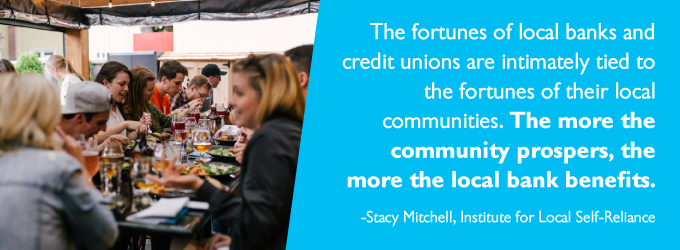
Consumers who choose to bank locally create a direct impact on the growth and health of their local economy and community. Instead of simply parking their money at a large, national bank chain, consumers are partnering with their community bank to invest locally. This investment allows community banks to make loans to local businesses, as well as additional resources such as financial advice, online resources, and networking opportunities for community entrepreneurs. Your financial institution can emphasize this advantage by highlighting your investments in local businesses as well as your charitable giving and community involvement on your website and in physical branches.

How To Motivate A Switch

As a community bank, you know that the economic health of your business contributes to the overall health of your community. Public awareness is with you on this, as the movement to reinvest in community businesses has become mainstream. Yet while “shop local” decals may bring more customers into the local hardware store, making the commitment to community banking isn’t always as easy. Here are 4 key points to use in your marketing and communication materials to motivate people to make the switch.

  • Lower Fees: Megabanks have a fee for just about everything, and they continue to raise their rates. If you’re offering fee-free banking or free checking accounts, be sure to advertise these products. Do you offer ATM fee reimbursement? Advertise these perks and dispel any worries that you can’t compete with the convenience of a larger bank.
  • Service & Products: Small banks offer many of the same products as national banks, only better. Play up your excellent customer service and the customizable products that are tailored to the needs of your community.
  • Community: By creating jobs, giving back to local charities, and serving on local boards, small banks are true partners with their community.
  • Environmental Concerns: National divestment campaigns are underway, promoting the shift away from megabanks that use their assets to invest in oil, gas, and chemical industries. Organizations like Green America offer a step-by-step guide to assist consumers who want to switch to a community bank. If your bank invests in sustainable or socially-responsible companies, be sure to market it.